
bekaa · May 1, 2023
Ain-Harcha Temple
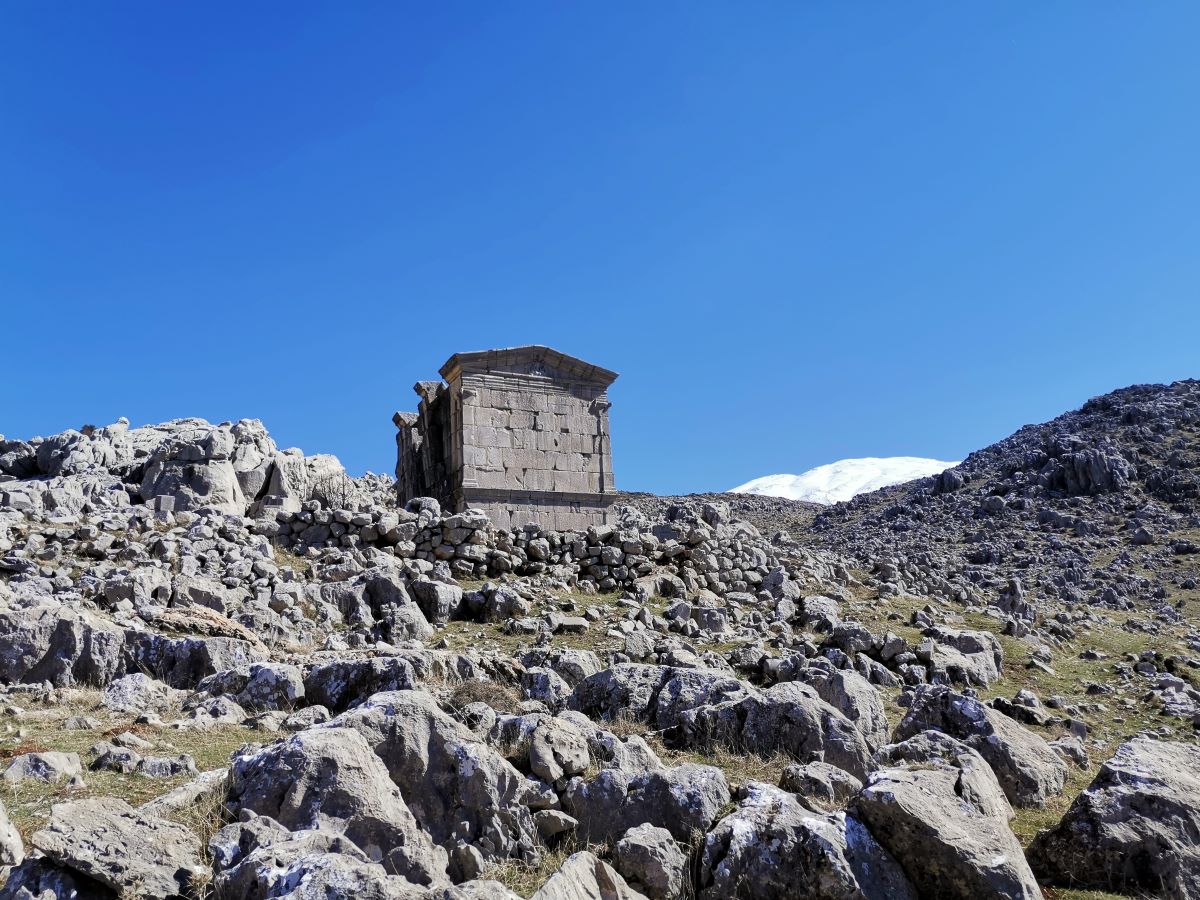
Ain-Harcha village houses a Roman-era sanctuary, bordered by remnants of an old settlement and a necropolis.
Date
Carved on a stone in Latin inscription, the construction of the temple is attested to the year 116 AD.
The inscription states the following: “To the ancestral god, Alexandros son of Alexandros dedicated this altar at his expense, with his wife, for his children, in fulfillment of a wish, the year 226” (226 equals 116 during the Sidonian era).
Structure
Open to the east, the temple rises on a high four-seat podium, and includes a _pronaos_ (space of the temple’s entrance) and a _cella_ (section where the deity is venerated) at the bottom of which is the platform of an _adyton_ (sacred area inside the cella).
Following the Ionic order, the structure is built in a _distyle in antis_ design – a temple with the side walls extending to the front of the porch and terminating with two _antae_ (doorway pillars), the pediment being supported by two pilasters (a rectangular column projecting from a wall).
The temple’s interior podium has collapsed with time, while the ornaments and niches of the _pronaos_ and the _cella_ are degraded.
Facing the temple’s entrance, a couple of rocks holding a Greek inscription can be noticed, as well as the foundations of other structures that can be the remains of an altar or a facility that was part of the sanctuary.
On the southern side, and at the foot of the temple’s fondations, a couple of sarcophagus can be noticed, with one of them bearing beautiful bas-reliefs of what appears to be a person wearing a priestly tunic – possibly the tomb of the temple’s priest?
Deity
On the southern side of the exterior façade, the _pediment of the temple_ (triangular gable forming the end of the roof slope) is decorated with a bust of Luna, Goddess of the Moon. On the eastern side of the temple, a rock lays on the ground with a figure of Sol, God of the sun.
These two figures, reflect the cosmic character of the sanctuary and express the omnipotence of a deity sovereign.
Accessibility
After following the GPS location shared in this article, visitors should take a 30min walk up the mountain on a clear open trail. Once you reach the old settlement, you can notice the temple to the east.
_References:_
_La vie Religieuse Au Liban Sous L’Empire Romain – Julien Aliquo_


